The Baci Ceremony
Birthday, anniversary or just welcoming/well-wishing ceremonies for Rivertime guests can be arranged with two or three days notice for the local community and village elders. This most popular of Lao traditional ceremonies involves the ritualistic tying of holy cotton threads to ensure blessings of the spirits on specific persons, activities or places. It is believed to restore the natural order of things and bring communities closer together.
The ceremony originated in the Hindu tradition and began to mix with Buddhist traditions in Laos 500 years ago. It is performed by a ‘mor phon’ who is usually an elder who has spent some time as a Buddhist monk. The mor phon and invited guests sit around a baci centerpiece which is an elaborately decorated flower arrangement. A long chain of cotton threads is placed in the hands of guests connecting them to each other and to the centerpiece. The mor phonthen lights candles on the centerpiece and begins to chant Buddhist scriptures in the ancient Pali language
The guests clasp their hands together in respect and those familiar with Pali prayers participate in various points of the chanting. On conclusion of chanting (which usually lasts around twenty minutes), holy scented water is sprinkled over the guests and uncooked rice grains are thrown in the air. At this point, special guests such as foreigners may be presented with an offering bowl containing cooked chicken and other simple foods. The special guests must hold aloft the offering bowl in their palms and drink from cups of Lao rice wine. It is believed that this will ensure that they have sufficient to eat and drink in the future.
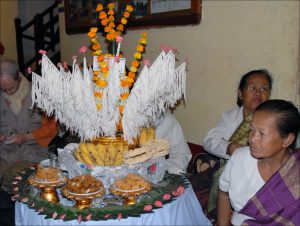
Following this, the mor phon and other guests tie cotton threads on guests’ and each others’ wrists. These cotton threads, as well as the centerpiece, have been prepared by the women of the group in advance of the ceremony. The threads used in the baci ceremony are usually white as Lao people believe that white represents innocence, friendship, and kindness. However, recently, other colors such as red, yellow and black have been introduced to the ceremony. Red threads are believed to represent bravery; yellow can symbolize faith, and black can mean sympathy for a person’s sadness or loss. Before tying on the threads, a knot is tied in the strings. This, it is believed, firmly ties the guests’ souls to their bodies.
While tying on the threads, good wishes are offered to the recipient, usually along the lines of, “Bad things go out,” “Good things come in,” or “I wish you good health, long life, and happiness”. The form of these good wishes is very flexible and may be offered in any language. The recipient then raises their right hand to chest level (nop) to show respect for the person who ties the string. During this process, the mor phon and special guests will be encouraged to drink more ceremonial glasses of Lao rice wine or similar alcoholic drink.
Traditional Lao Music and Dance
During certain times of the year such as important national festivals or family occasions, traditional dance exhibitions are held at Rivertime. However, Rivertime guests can book a traditional dance performance any time with a few days’ notice and a small payment to a local dance troupe. The dancers wear the traditional clothes of their ethnic group and are accompanied by ancient traditional musical instruments such as the Lao khaen.
Alms-Giving (Takbaat)
On certain days of each month, inhabitants of the villages near Rivertime Resort attend a ceremony and line up to present offerings of simple food to monks from the local temple as they walk by on their morning alms round. Our guests are welcome to attend the ceremony and will be dressed accordingly by our staff and instructed on the basic etiquette! It’s really not a complicated affair, just do what everyone else is doing! This centuries-old tradition is followed by young and old, men and women alike (Note: women must take care never to touch a monk).
However, Takbaat does usually start about 7 am!
Traditional Lao Festivals
People in the Lao PDR organize a multitude of festivals (boun) to celebrate both religious and secular events. International holidays such as New Year’s Eve on December 31 are widely celebrated, although other Christian and Muslim holidays are not. Various ethnic groups have their own unique festivals in specific regions, while other celebrations take place throughout the country. Some secular celebrations (such as National Day every December 2) are timed according to the modern European calendar, while many other events follow the traditional lunar cycle (in which each month has 28 days) and therefore vary in timing from year to year on the European calendar.
Some Of The Important Traditional Festivals Which Take Place In And Around Vientiane Are:
Hmong New Year (Late-November Or Early December)
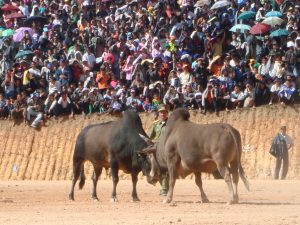
The Hmong ethnic group celebrate their New Year in late-November or early-December and hold a huge festival near our resort in which all the local Hmong villages participate in events such as traditional dancing, bullfighting, and ethnic sports, including the ball-throwing game which is used for young people to let other young people of the opposite sex know they are interested in them!
The Lao New Year (Pimai) Around April 13-16
This festival mobilizes the entire population of Laos to celebrate the Buddhist New Year. Pimai is combined with the water festival which is believed to cleanse the sins of the previous year. Lao people of all ages line the streets armed with a wide variety of water containers which they use to throw water over cars, motorbikes, and passers-by.
The Rocket Festival (Boun Bang Fai) April – May
Boun Bang Fai takes place after Pimai. During the festival, homemade rockets of all shapes and sizes are launched throughout the country. Rockets which fail to launch can bring mockery to the owner, while the one which raises the highest will be seen as the victor. The owner of this rocket will be carried by the crowd and very often thrown into the river. The rocket launching is an attempt to fertilize the clouds in order to bring rain to irrigate the newly-planted wet season rice crop.
Boun Ok Phansa And The Boat Racing Festival October
This festival is held on the 15th day of the growing moon, in the 11th month of the Lunar Calendar to celebrate the end of Buddhist Lent and the Rains Retreat for Buddhist monks. Several different Buddhist and Animist practices are combined, candle processions and many other events are organized. In the evening on the Mekong and other rivers, we can see people setting adrift thousands of tiny boats made from banana leaves. These boats, decorated with incense, flowers and lighted candles, are sent out to pay respect to the spirits which inhabit the rivers. In addition, there are boat races organized on the country’s main rivers with rowing teams from all over the country as well as Thailand, China and Myanmar. Riverbanks are lined with food stalls, temporary discos, carnival games and beer gardens for three nights.